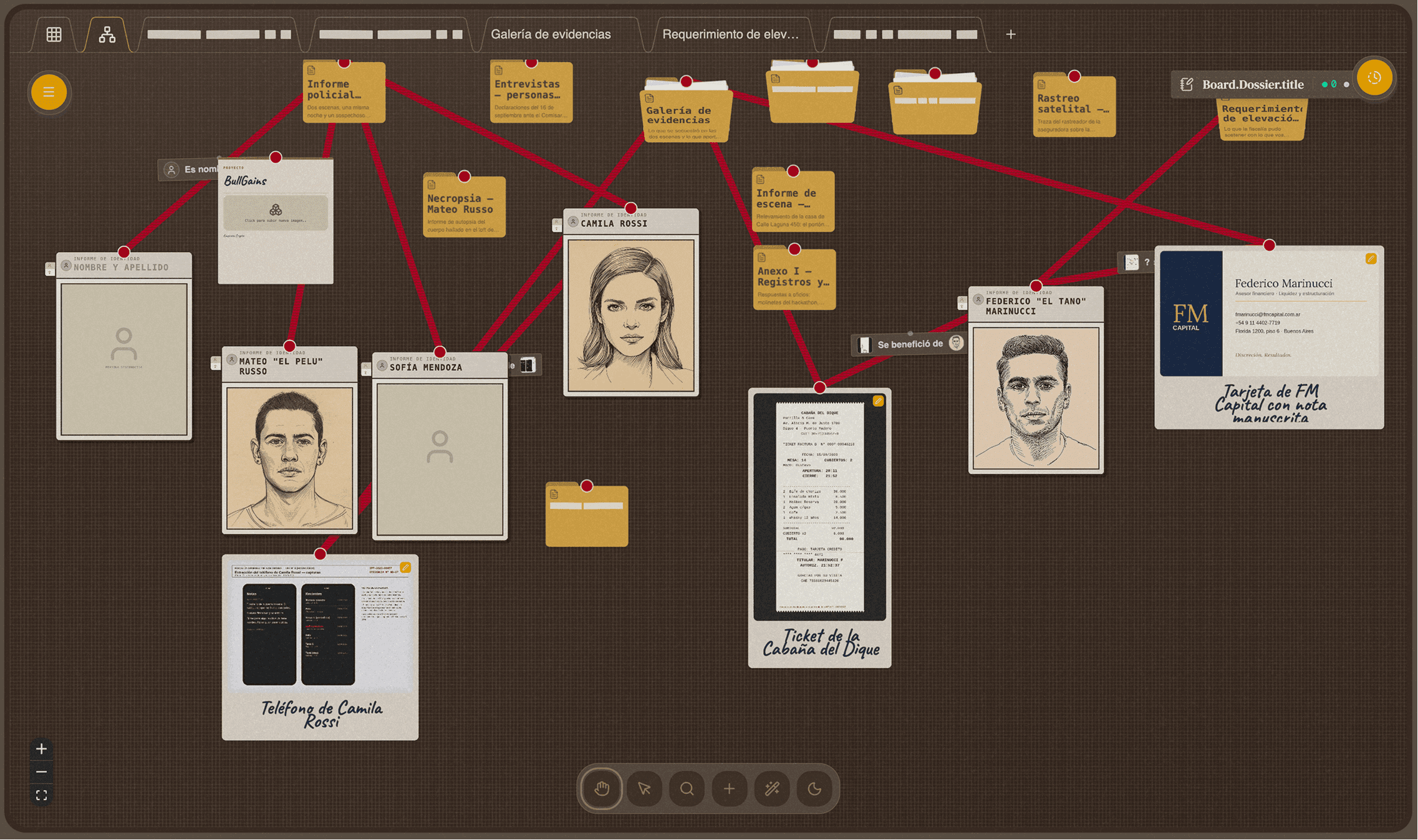
A detective game isn't a game of trivia about detectives. It's an open case file and a whole evening to decide who's lying.
ECI stands for Equipo Civil de Investigación — Civilian Investigation Unit. It's a platform where you open a fictional criminal case — witness statements, forensic reports, crime scene photos, audio, maps and alibis — and investigate until you can name who did it. It runs in the browser, alone or with up to ten people, and every answer is verified instantly.
This is how it works under the hood: what's inside a case file, what the board is for, how long it takes, and how it compares to an escape room or a mystery board game.
What a case actually is
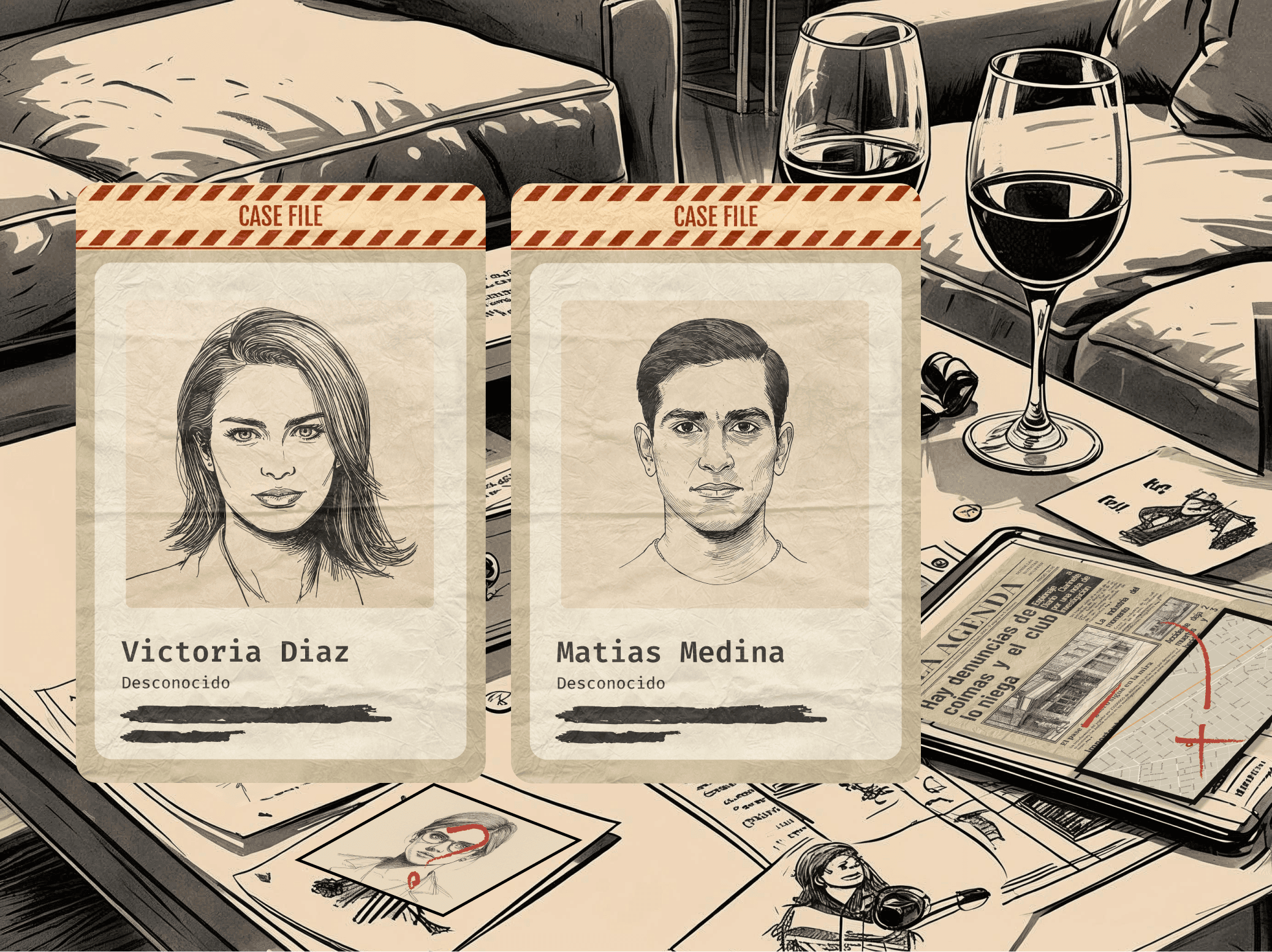
A case is a digital file. Not a PDF to print, not an app to install: a file you open in the browser and dig through.
There are four kinds of material inside:
- Statements. Declarations from the people involved. Some are true, some are incomplete, and some are deliberate lies. Telling them apart is half the work.
- Physical evidence. Crime scene photos, objects, documents, screenshots, audio and video. You examine them with forensic tools: decoding ciphers, comparing fingerprints, checking whether an alibi lines up with the timeline.
- Context. Maps, timelines, relationships between people. What a real investigator would have on the desk.
- Objectives. The questions the case asks you to answer. Each one is analyzed and verified instantly, so nobody spends two hours accusing the wrong person without finding out.
None of it is organized for you. The file arrives the way a real file arrives: complete and messy.
The board is half the game
The thing that separates ECI from reading a document is the board.
It's a precinct wall, digital: you drag people, clues, places and times around and connect them with threads. A theory stops being an idea in somebody's head and becomes something the others can look at and argue with.
And it's synced live. Share the link and up to ten people work on the same board from their own screens: if someone moves a clue, you see it move. No turns, nobody waiting. Just several people going through different documents at the same time and telling each other what they found.
That's why it works just as well with everyone around one table as with half the group in another city.
How you play, in three steps
- Pick a case. They vary in difficulty. Incendio digital is case #ECI-001 and the one to start with.
- Open the file and share the link. Each person joins from their own device. Nothing to install.
- Complete the objectives. Investigate, build the board, answer. The system verifies each answer as you submit it.
There's no clock running. A case takes two to three hours, but you can pause and come back another day: the board stays exactly as you left it.
How it differs from an escape room or a board game
The three look similar from a distance and are different experiences up close.
| Escape room | Mystery board game | An ECI case | |
|---|---|---|---|
| What you do | Solve puzzles to get out | Follow a script, in turns | Investigate material and draw conclusions |
| The clock | Running, and pressing | Depends on the game | There isn't one |
| Who acts | In turns or in waves | In turns | Everyone at once |
| Remotely | Almost never | Difficult | Yes, that's the normal case |
| If you get stuck | A hint from the operator | Re-read the manual | The file holds more material than you need |
| What's left after | The photo at the exit | The box back on the shelf | The argument over who suspected whom |
The underlying difference: an escape room gives you puzzles, and an ECI case gives you contradictory information. A puzzle has one answer waiting to be found; a case file has several versions of the same event, and you have to decide which one to believe.
Who it works for
- As a couple, as a Friday or Saturday plan that isn't bingeing a show. There's a guide to plans for two with more detail.
- With friends, for when everyone wants to get together and nobody has an excuse. Two or three hours with something to argue about.
- Long distance, which is where the difference shows most: it isn't a video call with a game in the background, it's shared work.
- For work teams, because it forces coordination without hierarchy: the team that listens wins. It's laid out in team building activities.
- As a gift, because it's 100% digital: it arrives instantly, nothing to ship. It's in original gift.
What you need to start
A browser. That's it.
No downloads, no app, no delivery to wait for. There's one complete case, free, so you can try the whole format before deciding whether you want another: it isn't a ten-minute demo, it's a real case with its file and its objectives.
If you like it, Incendio digital is the next step, and La Cripto Estafa is on the way.
Frequently asked questions
Can I play alone?
Yes. The case is the same; what changes is that you have nobody to argue theories with, and that's a good part of the fun. If it's your first time, play alone to get the format and then invite someone.
How many people can play at once?
Up to ten on the same board. Above six it's worth splitting them by section of the file, otherwise people trip over each other.
Do I need to know anything about criminal investigation?
No. Everything you need is inside the case. The forensic tools work by clicking a button, not by configuring anything.
What if we get stuck?
It happens, and it's part of the game. The file always holds more material than you strictly need: if one path leads nowhere, another one works. Going back to the statements and hunting for the contradiction usually breaks the deadlock.
Can we pause?
Yes. The board is saved exactly as you left it. A case split across two evenings works well.
Are the cases real?
No. They're fiction. Any resemblance to reality is a coincidence.
The question every case ends up asking isn't "who did it?" but "why did you believe that person?". That conversation is the product. The case file is the excuse.
Start with the free case and see how long it takes before the first argument.
%20(1).png&w=3840&q=75)