Watching a show at the same time isn't doing something together: it's two people watching the same thing separately. And by week three, you can tell.
Distance doesn't break up a couple. What breaks it is the video call routine where you've said everything in the first ten minutes and then there are forty more of awkward silence with the camera on. What's missing isn't time or willingness: what's missing is something to do with your hands while you talk.
These are seven plans that work at any distance, ordered from most to least preparation. None of them require being in the same city or even the same time zone.
Why most long-distance plans burn out fast
Almost every "long-distance couple game" you'll find has the same problem: they're turn-based. One asks, the other answers. One plays, the other waits. The conversation stops every time it's the other person's turn, and the video call becomes a waiting room.
The plans that last for months share three things:
- There's a shared goal, not a winner. Competing at a distance is tiring; building something together isn't.
- Both people act at the same time. Nobody waits their turn.
- They end. A plan that never finishes gets abandoned; one that runs two hours and closes leaves you wanting to do it again.
Keep those three criteria. They'll rule out 80% of the lists floating around.
1. Solving a criminal case together
It's the plan that best meets all three criteria, which is why it goes first.
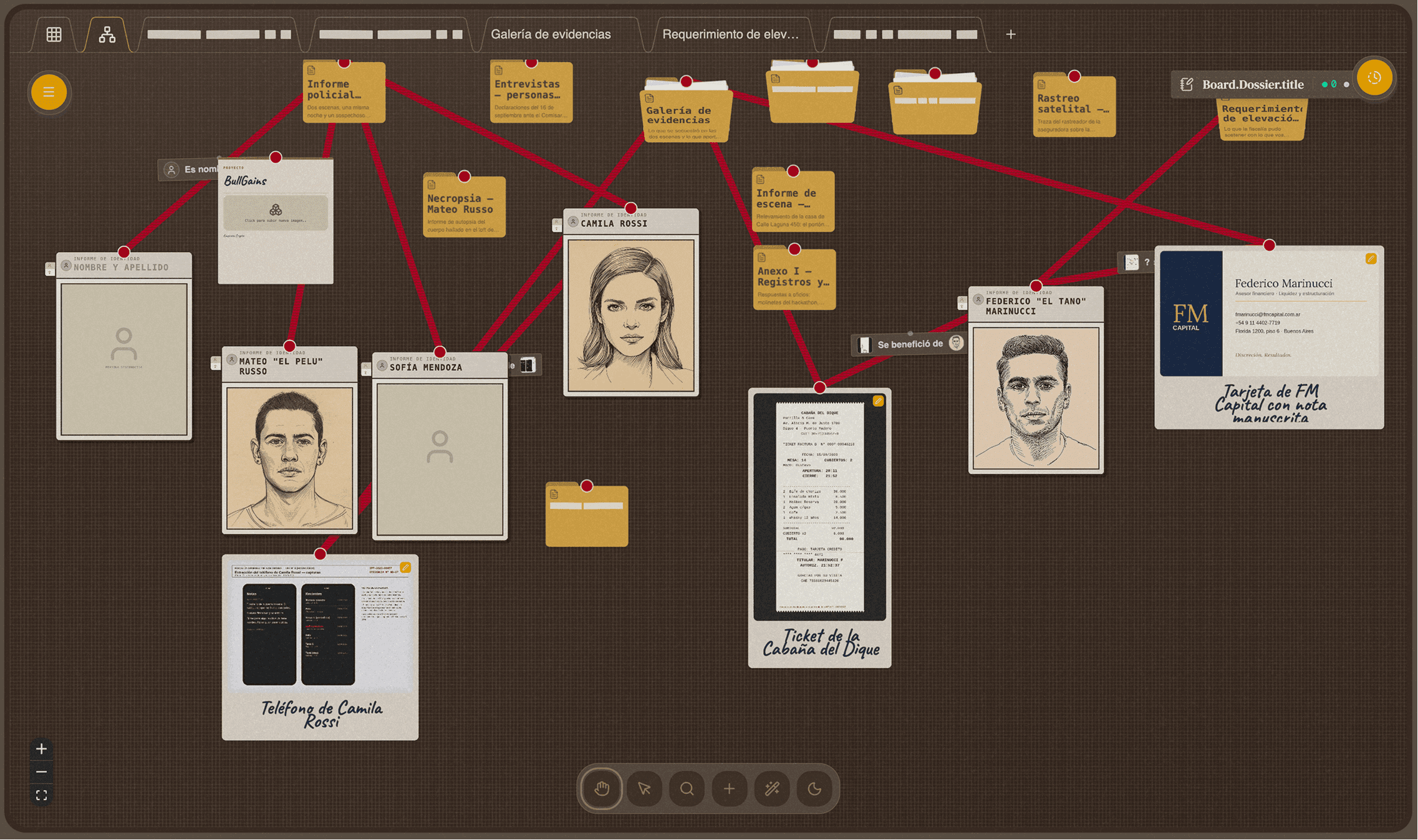
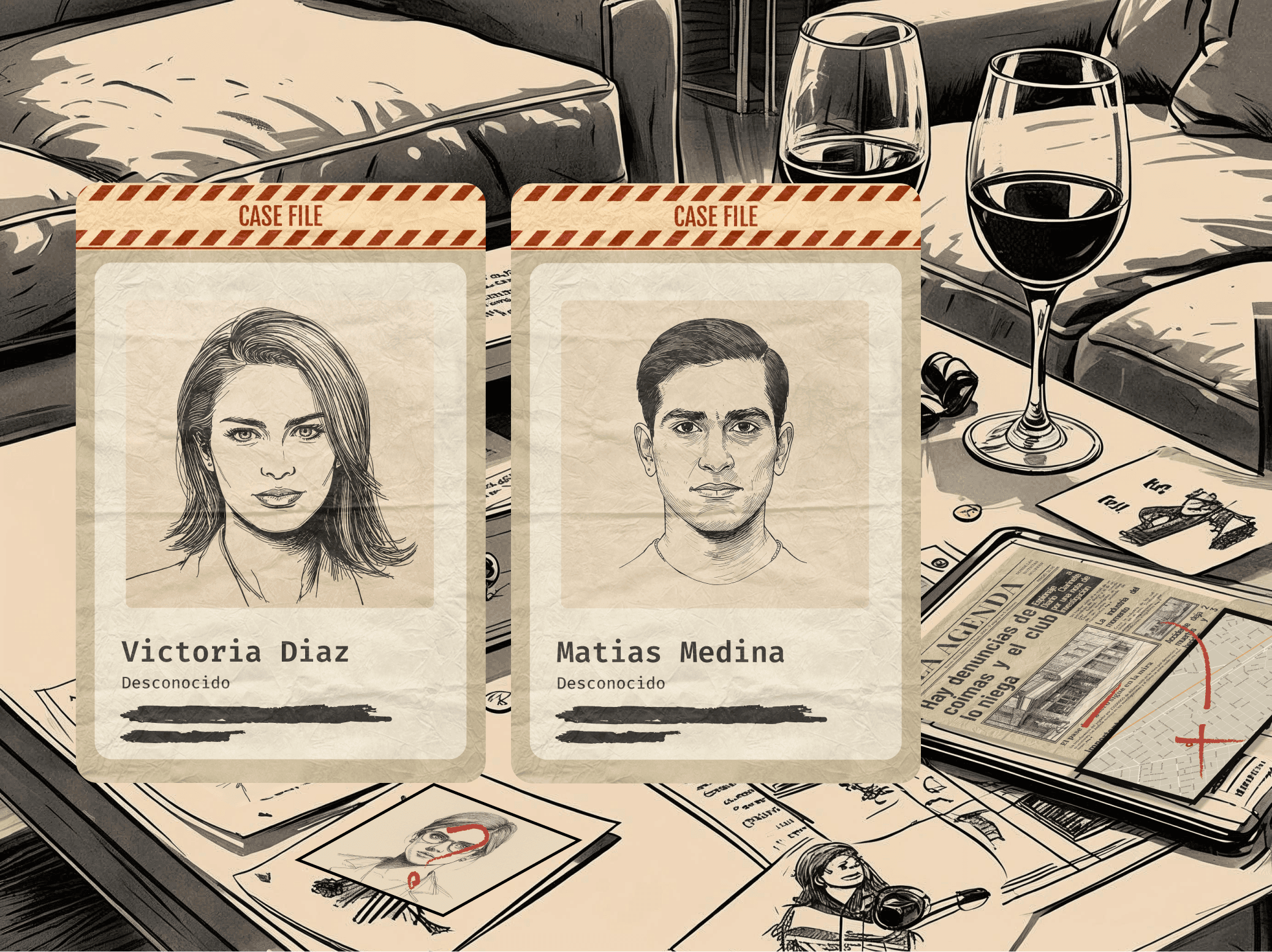
Here's how it works: you open a case file — witness statements, forensic reports, alibis, photos, maps — and you have to reconstruct what happened. Each of you investigates from your own screen, in your own home, but you share one live board: if your partner moves a clue, you see it move. There are no turns. There are two people going through different documents and shouting "come look at this!" over the video call.
It runs two to three hours, which is exactly how long a good long-distance Saturday night lasts. And it ends: you complete the case objectives and the system verifies each answer instantly, so you know whether you got it right or whether you've spent the last two hours accusing the wrong person.
Casos Criminales has a free case you can try without a card. If you like the format, there are more; if not, you lost one night and gained a story.
Great if: you want something that feels like going out, without going out.
Skip it if: one of you gets frustrated quickly with logic problems.
2. Trivia about the two of you
Free, zero technical setup, and surprisingly revealing.
Each of you secretly writes ten questions about the relationship: "what did I order the first time we went out to eat?", "which movie did I say I hated but have watched three times?". You ask them on the video call. The point isn't getting them right: it's the wrong answers.
One tip that changes the game: no questions about facts (dates, names, places). Only about tastes, opinions and memories. Facts get memorized; opinions get discovered.
3. Cooking the same recipe at the same time
Pick a recipe neither of you has ever made, shop for it separately, and get on a call to cook in parallel with your phone propped up on the counter.
It's the most domestic plan on the list, and that's exactly why it works: it reproduces the feeling of living together. You pass each other the salt, you warn each other something's burning, you eat the same thing. Then you have dinner together on camera, which reads as sad written down but isn't when you both have the same plate in front of you.
4. A classic board game, online
Catan, Carcassonne, Codenames and Dixit all have decent online versions. They work, with one caveat: they're turn-based, so they fall into the problem from the beginning.
The fix is to pick the cooperative ones, where you both play against the game. Hanabi and Pandemic are the best examples. There the conversation doesn't stop: it is the game.
5. A two-person book club
Pick a book, set how many chapters per week, and once a week get on a call just to talk about it.
It sounds slow and it is slow — on purpose. It's the only plan on this list that builds something over months instead of resolving in one night. And it gives the weekly call a topic that isn't "how was your day?".
Pick fiction, not self-help or business books. You need characters you can disagree about.
6. A virtual museum tour
The Louvre, the Prado, the Met and dozens more have free virtual tours that are genuinely good.
The plan only works if you add one rule: each person picks three works and has to explain to the other why they picked them. Without that rule, it's scrolling photos in silence. With it, it's a date.
7. Writing a story together
One shared document. Each of you writes a paragraph a day, without agreeing in advance where it's going.
It's the lowest daily effort on the whole list — two minutes — and the one you enjoy most in hindsight. Two months in, you have something that exists and wouldn't exist if you lived in the same city.
How to choose based on the time you have
| Time available | Recommended plan |
|---|---|
| 20 minutes on a weeknight | Trivia about the two of you (2) or the shared story (7) |
| An hour | Co-op game online (4) or book club (5) |
| A whole evening | Criminal case (1) or cooking together (3) |
| A slow Sunday | Museum tour (6) |
The most common trap is saving the long plan for "when we feel like it". Put it on the calendar, the way you would an in-person date. A long-distance plan without a date doesn't happen.
Frequently asked questions
Do these work if we're in different time zones?
Plans 5 and 7 are asynchronous: they don't require being online at the same time. The rest do, but a criminal case can be paused and picked up later; you don't have to finish it in one sitting.
Which one should we try first?
The trivia (2). Zero prep, zero risk, and it tells you a lot about whether the "game" format is going to work for you as a couple.
Is there anything we can play without installing anything?
Yes. The criminal cases run in the browser: you share a link and each person joins from their own device. The museum tours too.
What if there are more than two of us?
Every plan on the list scales to groups except the trivia. A criminal case, for example, holds up to ten people on the same board, so it works just as well for a couple as for a night with friends scattered across the country.
Distance doesn't get fixed by talking more. It gets fixed by having things to talk about. Pick one of the seven, put it on the calendar this week, and see which of the three criteria from the beginning it meets best for you.
%20(1).png&w=3840&q=75)