It happens every year: someone in HR sends the email in the first week of November, the answer is "let's do something different this year", and three weeks later the team ends up at the same drinks thing as always. Plastic cups, a ten-minute speech, and half the room watching the clock.
It isn't a lack of creativity. It's that a year-end event has three constraints almost no activity solves at once: a tight budget, hybrid or fully remote teams, and a December calendar with no room in it.
These eight ideas are ordered by that reality, not by how good they look in a photo. At the end there's a table to pick one based on team size and setup.
What a year-end event should actually do (and what it can't)
Before choosing, it's worth being honest about the goal. A year-end event is not team building. It won't fix a conflict between departments or improve communication on a team that doesn't talk. That takes months.
What it can do, and it's plenty:
- Close the year. Mark that it's over. Without a closing ritual, the new year starts like any other Wednesday.
- Let people actually see each other. On remote teams, most people only know each other as rectangles in work meetings.
- Recognize someone. Not with a generic certificate: with something specific that a person actually did.
Any activity that hits two of the three is worth the meeting. The ones that hit none are, in fact, just drinks.
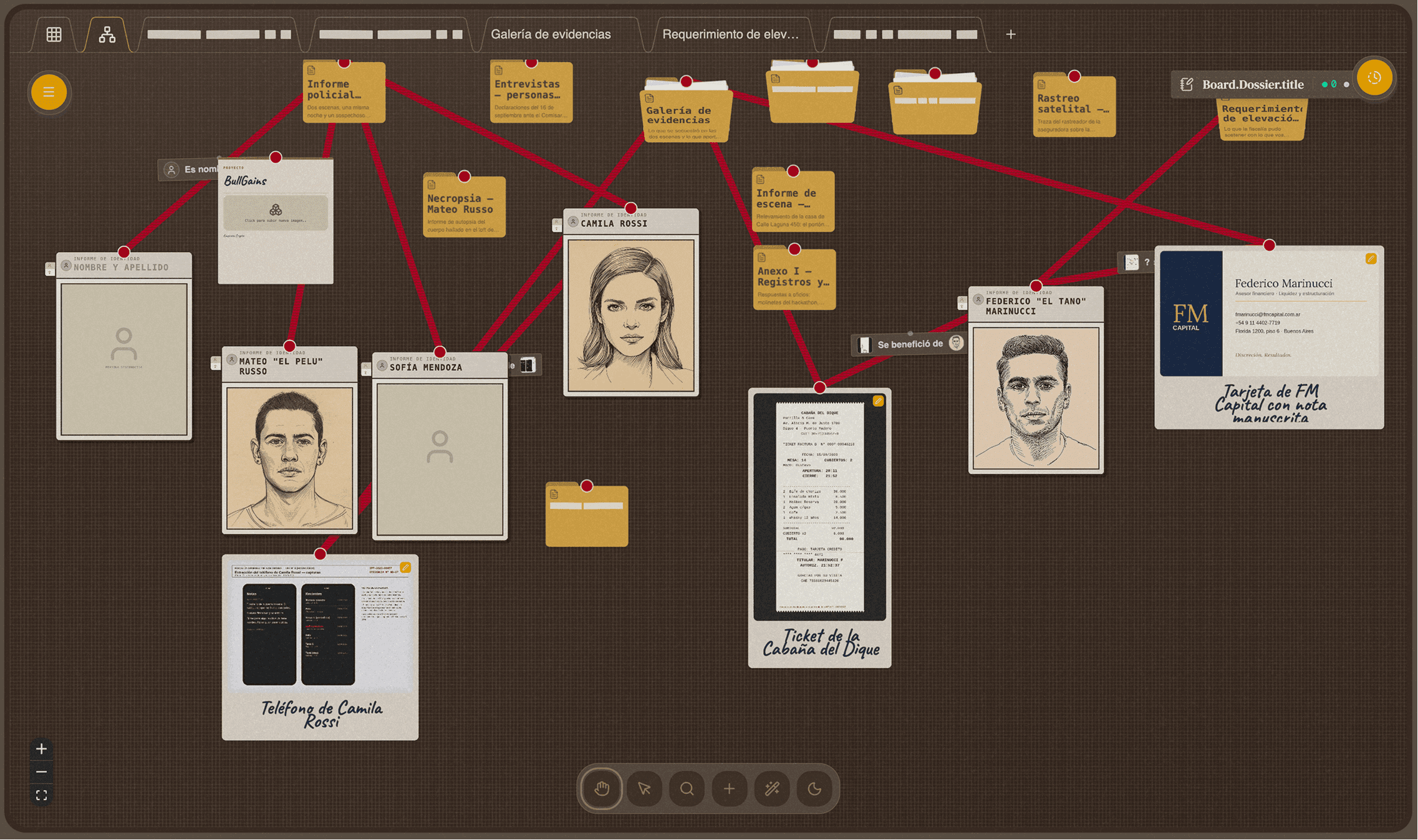
1. Solving a criminal case in teams
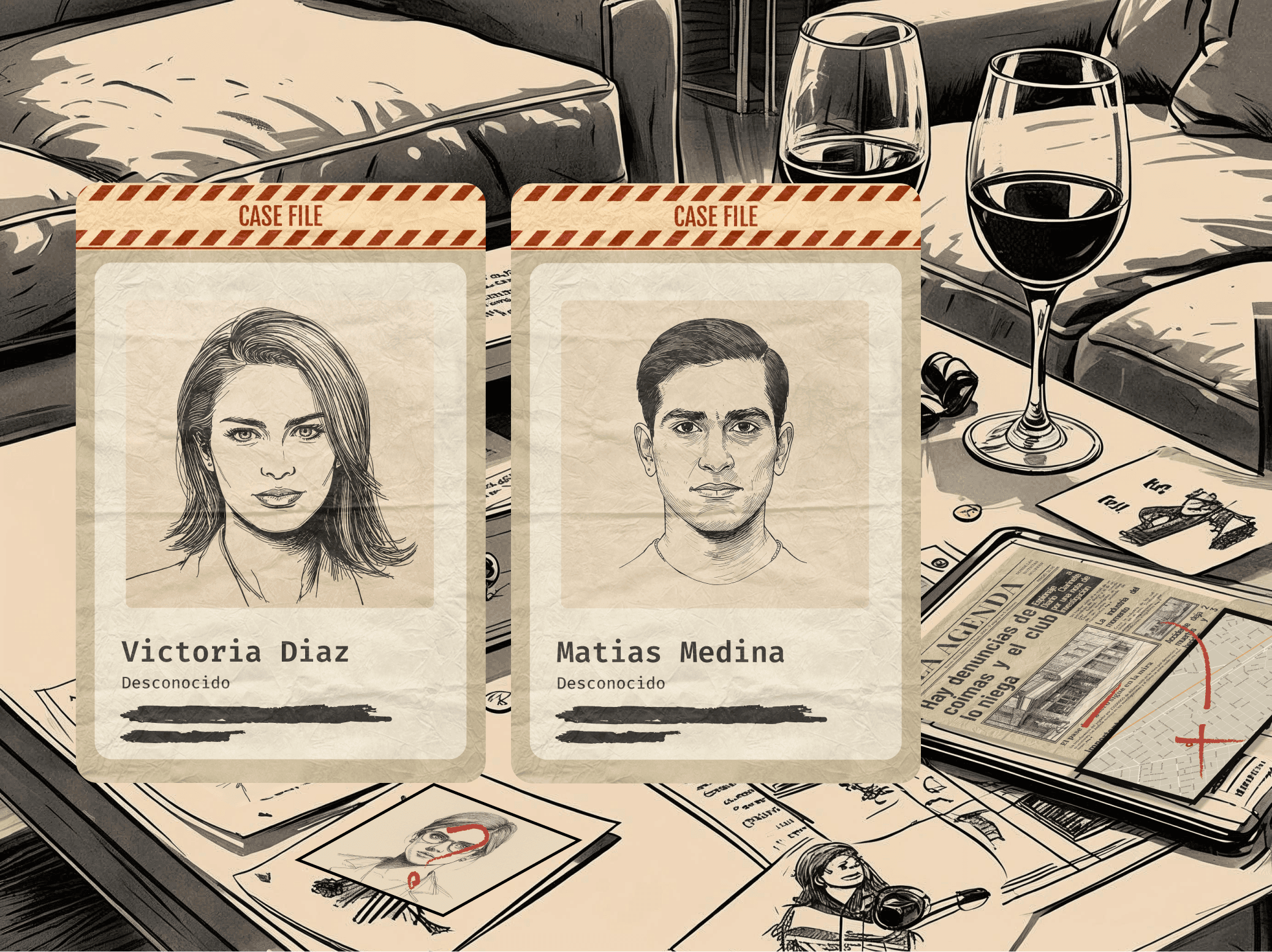
Split the group into teams of up to ten, and each team gets a case file: witness statements, forensic reports, alibis, photos, maps. They have two or three hours to reconstruct what happened and name a suspect.
It works well for a year-end event for three concrete reasons:
- It's 100% online, so the remote half of the team isn't watching from the outside. You share a link and each person joins from their own device, whether they're in the office or at home.
- It mixes departments. A case needs someone who organizes data, someone who notices details, and someone willing to commit to a theory. Those three profiles are almost never on the same working team.
- It has an outcome. You either get it right or you don't, and the system verifies each answer instantly. That generates hallway conversation for days, which is more than a round of drinks leaves behind.
There's a free case so you can try it with a small group before committing budget for the whole company.
Budget: low. Setup: remote, in person or hybrid. Team size: 5 to 100+ (in parallel groups).
2. A year-in-review retro, played as a game
A team retro, but for the whole year and without the solemnity of a management meeting.
A shared board with three columns — what went well, what hurt, what we learned — and fifteen minutes of silent writing before anyone speaks. That initial silence is what makes it work: without it, the same three people do all the talking.
Save the last twenty minutes for a single question: "what do we want to be different in February?". February, not January. Nobody does anything in January.
Budget: zero. Setup: any. Team size: up to 25.
3. Internal awards, but specific ones
Year-end "awards" fail when the categories are generic: best teammate, most punctual. Nobody is moved by that.
They work when they're hyper-specific and nominated by the team rather than by management: "the award for the person who answered the 11pm message when production went down", "the award for the best uncomfortable question in a meeting".
It takes real prep work — a week of collecting nominations — and it has the best effort-to-impact ratio on this list.
Budget: zero to low. Setup: any. Team size: any.
4. A workshop in something that isn't work
Cooking, pottery, cocktails, phone photography. In person, or with a kit shipped to each home for the remote folks.
The advantage is that it levels everyone: in a pottery workshop the director and the intern are equally bad. The disadvantage is cost per person, which climbs fast on large teams.
Budget: high. Setup: in person (or remote with a kit). Team size: up to 20.
5. A day of volunteering
A day at a food bank, a nonprofit, or a donation drive organized by the team.
It's the activity people remember most a year later, and the one that fails worst when it's done out of obligation. Rule: participation strictly optional, and no photos for LinkedIn. If the activity exists for the photo, the team can smell it.
Budget: low. Setup: in person. Team size: up to 30.
6. A quick tournament
Ping pong, foosball, a video game, cards. Bracket drawn up, two hours, a ridiculous prize.
It's the lightest option on the list and the best one for teams that already get along. On teams that don't know each other, a competitive tournament tends to reinforce the existing cliques instead of mixing them.
Budget: zero to low. Setup: in person. Team size: 8 to 40.
7. A murder mystery dinner
A dinner where each person gets a character with a secret and there's a crime to solve between courses.
It's the in-person, more theatrical version of idea number 1. It goes well with extroverted teams and very badly with teams where people are embarrassed to act. Know your team before proposing it.
Budget: medium. Setup: in person. Team size: 8 to 20.
8. A team time capsule
Each person writes a prediction about the coming year — about the company, the team, the world — and they're all sealed to be opened next December.
It takes fifteen minutes, costs nothing, and it's the only activity on the list that pays off twelve months later. It works especially well bolted onto the end of the retro (idea 2).
Budget: zero. Setup: any. Team size: any.
How to choose in two minutes
| Your team's situation | Start with |
|---|---|
| Remote or hybrid, departments don't know each other | Criminal case (1) |
| Zero budget | Retro (2) + time capsule (8) |
| Hard year, lots of turnover | Internal awards (3) |
| Small in-person team | Workshop (4) or mystery dinner (7) |
| Large, scattered team | Criminal case (1) in parallel groups |
| They've already done everything | Volunteering (5) |
Frequently asked questions
When should we schedule it?
The second or third week of December. The last week already has half the team on vacation, and the first competes with quarter-end closings.
How long should it run?
Two to three hours. Under two isn't enough for people to loosen up; over three and only half the team is still really there for the last stretch.
Does this work for fully remote teams?
Ideas 1, 2, 3 and 8 were designed for exactly that. A criminal case online, in particular, has no "better in-person" version: everyone joins from their own screen, so nobody is a second-class participant.
Does it have to be during work hours?
Yes. A team activity outside work hours is unpaid work, and the team reads it exactly that way.
If you have to pick one and don't know where to start: run the retro (2) with the time capsule (8) attached at the end. It costs nothing, fits in two hours, and hits two of the three goals from the beginning. Everything else is budget.
%20(1).png&w=3840&q=75)